Blog Details
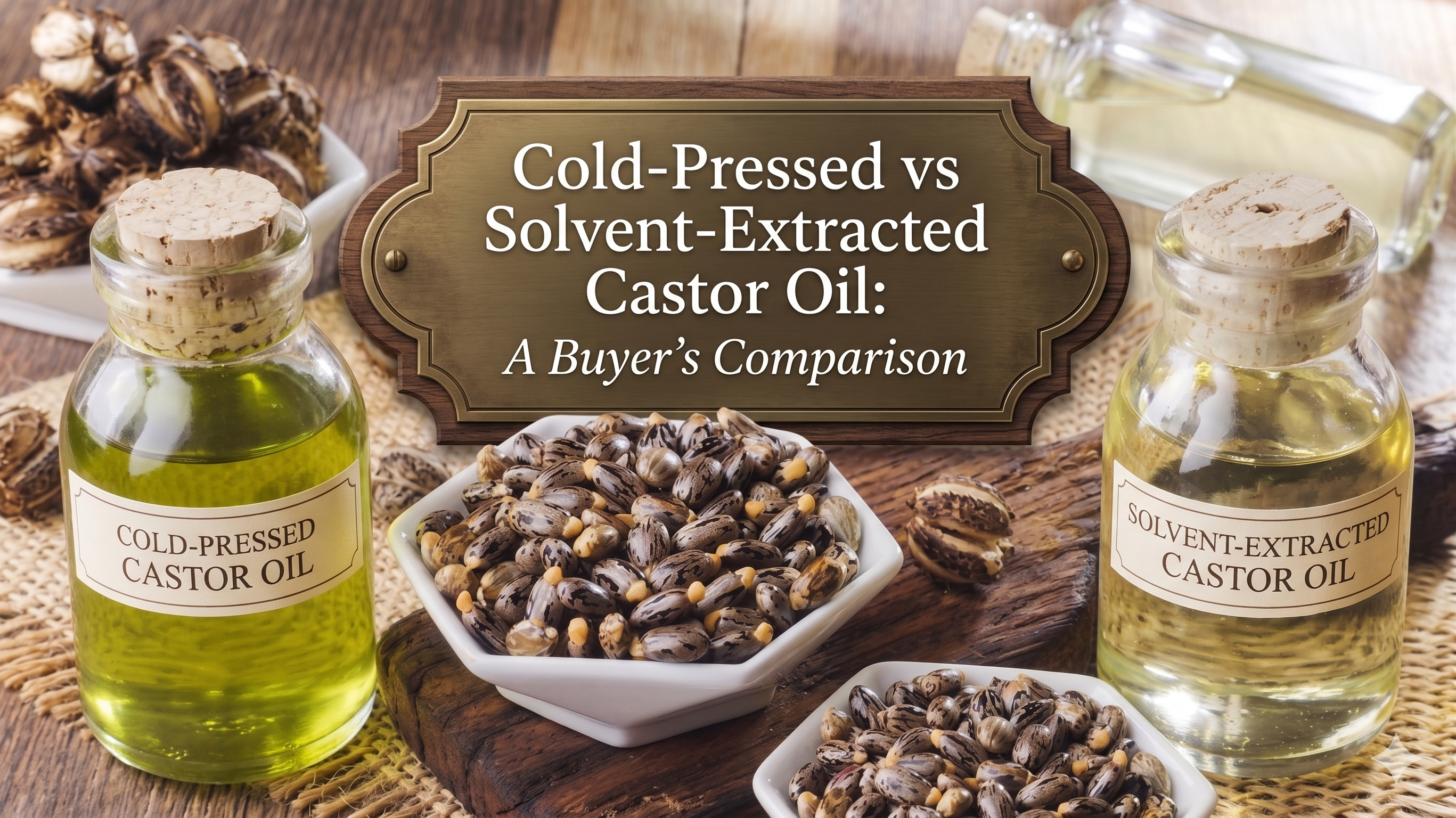
Quick answer
Cold-pressed castor oil is made by mechanical pressing at low temperature with no solvent — lower yield, minimal processing, and favoured for cosmetic and personal-care use. Solvent-extracted castor oil recovers the oil left in the press cake using a food-grade solvent, giving a higher overall yield and suiting large-volume industrial and chemical applications. Neither is "purer" by default once properly refined; the right choice depends on your application, label requirements and budget.
Both oils come from the same castor seed and share the same ricinoleic-acid chemistry. The difference is how the oil is removed from the seed. That choice affects yield, colour, processing temperature and how the oil is positioned commercially — but it does not change the fundamental fatty-acid makeup. For the full production chain, see how is castor oil made.
Cold pressing relies on mechanical pressure alone, kept at low temperature so the oil is not exposed to heat or solvent. The trade-off is yield: pressing leaves a fair amount of oil behind in the cake. In return you get a minimally processed oil with a clean profile, which is why it is favoured for cosmetics, personal care and clean-label uses. It typically commands a premium because of the lower yield and gentler handling.
Solvent extraction targets the oil that pressing leaves behind. The press cake is washed with a food-grade solvent that dissolves the residual oil; the solvent is then evaporated, recovered and reused. This pushes overall yield much higher, which keeps the oil cost-effective for industrial volumes and chemical applications. Properly refined and tested, it meets standard specifications and performs identically in most technical uses.
| Factor | Cold-pressed | Solvent-extracted |
|---|---|---|
| Method | Mechanical pressing, low heat | Solvent recovery from press cake |
| Yield | Lower | Higher |
| Processing temperature | Low | Moderate (with solvent removal) |
| Residual solvent | None | Removed; tested to spec limits |
| Typical positioning | Cosmetic / clean-label | Industrial / chemical feedstock |
| Relative cost | Higher | More economical |
| Best-fit uses | Skin & hair care, premium formulations | Lubricants, coatings, surfactants, derivatives |
Start from your application and any labelling constraints:
If you are weighing grades more broadly (FSG, FPD, PPG, commercial), our grade selection guide puts them side by side.
Cold-pressed is mechanically pressed at low temperature with no solvent (lower yield, favoured for cosmetics). Solvent-extracted recovers the oil from the press cake with a food-grade solvent (higher yield, suited to industrial use).
Not universally — it is better for clean-label and cosmetic uses. For industrial volumes, refined solvent-extracted oil does the same job at lower cost.
The solvent is evaporated and recovered, and refined oil is tested against residual-solvent limits, so finished oil should meet the limits on the CoA.
Often cold-pressed or a dedicated cosmetic/pharma grade for its minimal processing and pale colour — though many cosmetic ingredients are also derived from refined oil.